DIESEL SLED
PULL PREP
Competition-weight sled pull trucks need more than a big tune. Fuel system, injection, turbo configuration, and trans strategy all have to be matched to the class — and built to survive the load.
A SLED PULL BUILD
ISN'T A BIGGER
STREET TUNE.
The most common mistake on sled pull truck prep is sequencing. A shop adds a large single turbo, throws a high-fueling competition tune at it, and calls it a pull truck. That produces one of two outcomes: a clogged injection system within two events or an engine that can't survive the load curve a competition weight sled generates at the far end of the track.
Sled pull power delivery is not like street or towing power delivery. The load builds progressively — and a pull truck tune has to manage fuel delivery, EGT, and boost across a 300-foot pull, not just at initial hookup.
We build competition sled pull trucks the same way we build any heavy truck: consultation first, staged plan, prerequisite work before the big components. The fuel system has to support the injection pump demand. The turbo configuration has to match the class rules and power target. The transmission has to survive the hookup torque. And the ECM tune ties it together. That's six systems. We plan all of them before touching the truck.
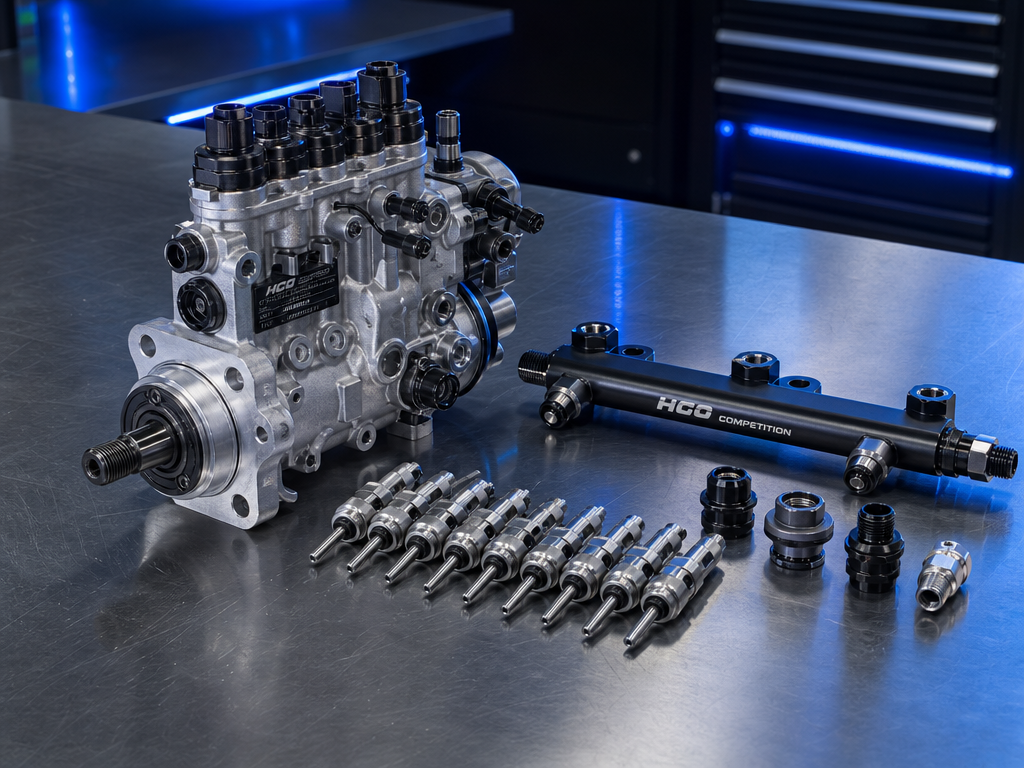
- Lift pump and fuel supply — FASS 150+ or equivalent
- CP3 injection pump conversion (platform-specific)
- Compound turbo configuration or large single (class-dependent)
- Trans brake or manual valve body (automatic platforms)
- Transmission build — converter and clutch pack upgrade
- EFI Live competition tune — class-specific fueling and EGT management
What Goes Into a Competition Sled Pull Truck
Each system is planned at the consultation. We don't add components incrementally without knowing what the class rules and power target require.
A FASS 150 or AirDog II-4G is the starting point on every pull truck build. Injection pump demand at full competition fueling will starve a stock lift pump. No lift pump upgrade, no reliable pull. We size the lift pump to the injection pump and fuel system being installed.
The CP4 pump on 2019+ Cummins and 6.7 Power Stroke platforms cannot survive competition fueling demand. CP3 conversion is required before a competition tune can be applied. On Duramax LML and L5P, CP3 conversion is the single highest-return fuel system modification for competition use.
Class rules and target power determine the configuration. Work Stock and Street classes often run a single high-flow turbo. Hot Street and Super Stock builds run S300/S400 compounds with a large primary and a small, fast-spooling secondary. Turbo sizing must match class displacement rules and fuel delivery capacity.
A trans brake holds the truck against the sled under brake torque while boost builds, then releases cleanly at the start. Without it, a high-torque diesel launches on a bog or a tire spin. Allison, 68RFE, and 6R140 platforms all require platform-specific trans brake valve body work.
A competition sled pull applies full drivetrain torque at hookup then holds it for 300 feet. Stock clutch packs, converter, and servo apply pressure aren't built for that duty cycle. We build transmissions for the torque the engine will produce — not the torque the stock tune produced.
The pull tune manages fuel delivery across the full 300-foot pull curve. EGT management, boost target, timing advance, and fueling rate are all calibrated for competition load — not street or tow duty. We use EFI Live on Cummins and Duramax; HP Tuners on Power Stroke. Competition tunes are separate from street tunes and stored as separate profiles.
Platform-Specific Sled Pull Notes
Each platform has a different starting point for competition builds. We don't apply the same approach to all three — the injection system, transmission, and turbo path differ by engine family.
- 5.9 12v and 24v: mechanical injection, no CP4 concern — CP3 already standard platform
- 6.7 (2013–2018): CP3 platform — strong starting point for competition builds
- 6.7 (2019+): CP4 → CP3 conversion required before any competition tune
- 68RFE: trans brake + converter upgrade for automatic platform pull trucks
- Aisin: more robust for competition torque; still requires trans brake valve body
- EFI Live is the calibration platform — multi-file for street vs. pull profiles
- LBZ: CP3 stock — proven competition platform, strong injector availability
- LML: CP4 → CP3 conversion is mandatory before any pull tune
- L5P: CP4 → CP3 conversion required; HP Tuners required for ECM access
- Allison 1000: TC upgrade, clutch pack build, and shift calibration for competition
- S400 single or S300/S400 compound depending on class and displacement rules
- 2011–2018: stronger starting platform for competition builds
- 2019+: CP4 → CP3 conversion required before any competition tune
- 6R140: trans brake valve body + clutch pack build for competition torque
- HP Tuners is the calibration platform across all 6.7 PS model years
- Compound turbo builds on 6.7 PS benefit from intercooler upgrade at Stage 3+
CALIBRATING
FOR THE
PULL CURVE.
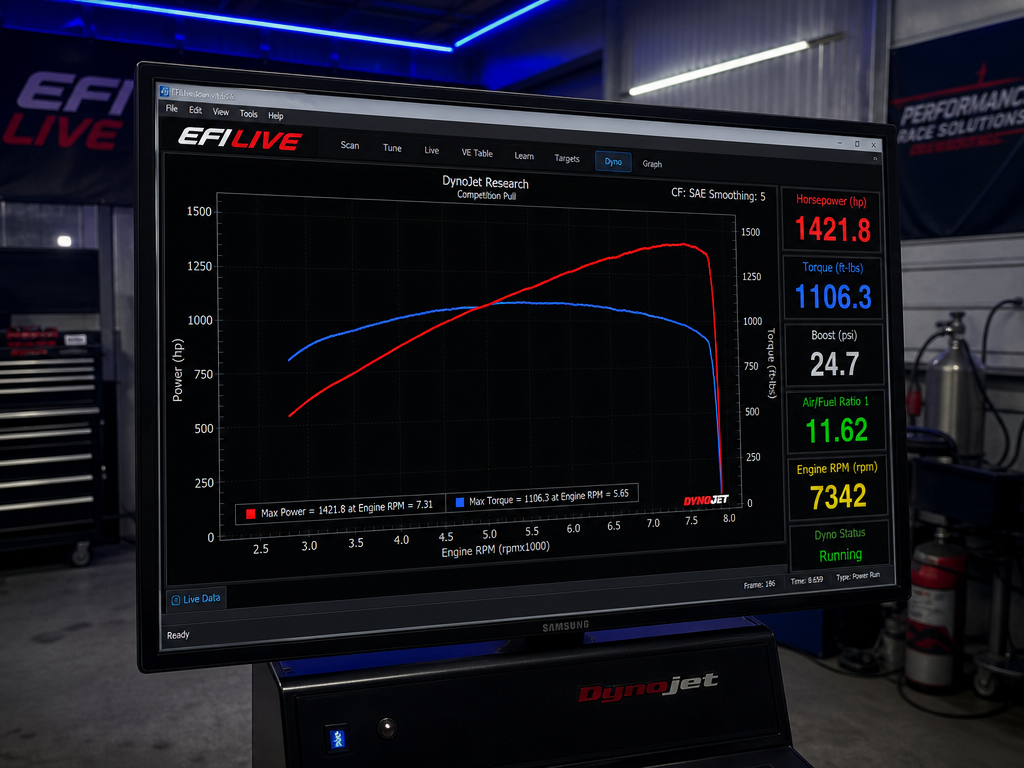
A street tune optimizes for throttle response at low RPM, driveability across the power band, and EGT safety during sustained load. A pull tune is built around a different objective: maximum torque and power delivery across a 300-foot, fixed-distance pull — with an EGT ceiling that has to hold for the duration of the pull, not just a towing stint.
The fueling rate, boost target, and timing advance tables in a competition tune look nothing like a street tune on the same platform. We store them as separate profiles in EFI Live. The driver switches profiles before the event. The truck returns to the street profile for the drive home.
See the build process for how we plan competition builds from consultation through calibration. Every sled pull build starts there — same process, different power target.
Diesel Sled Pull Questions
What we're most often asked about pull truck builds.
BRING THE CLASS RULES.
WE'LL PLAN THE BUILD.
Every competition prep starts with a consultation. Tell us the class, the platform, and the power target. We'll scope the full build from there.
BOOK YOUR CONSULTATION