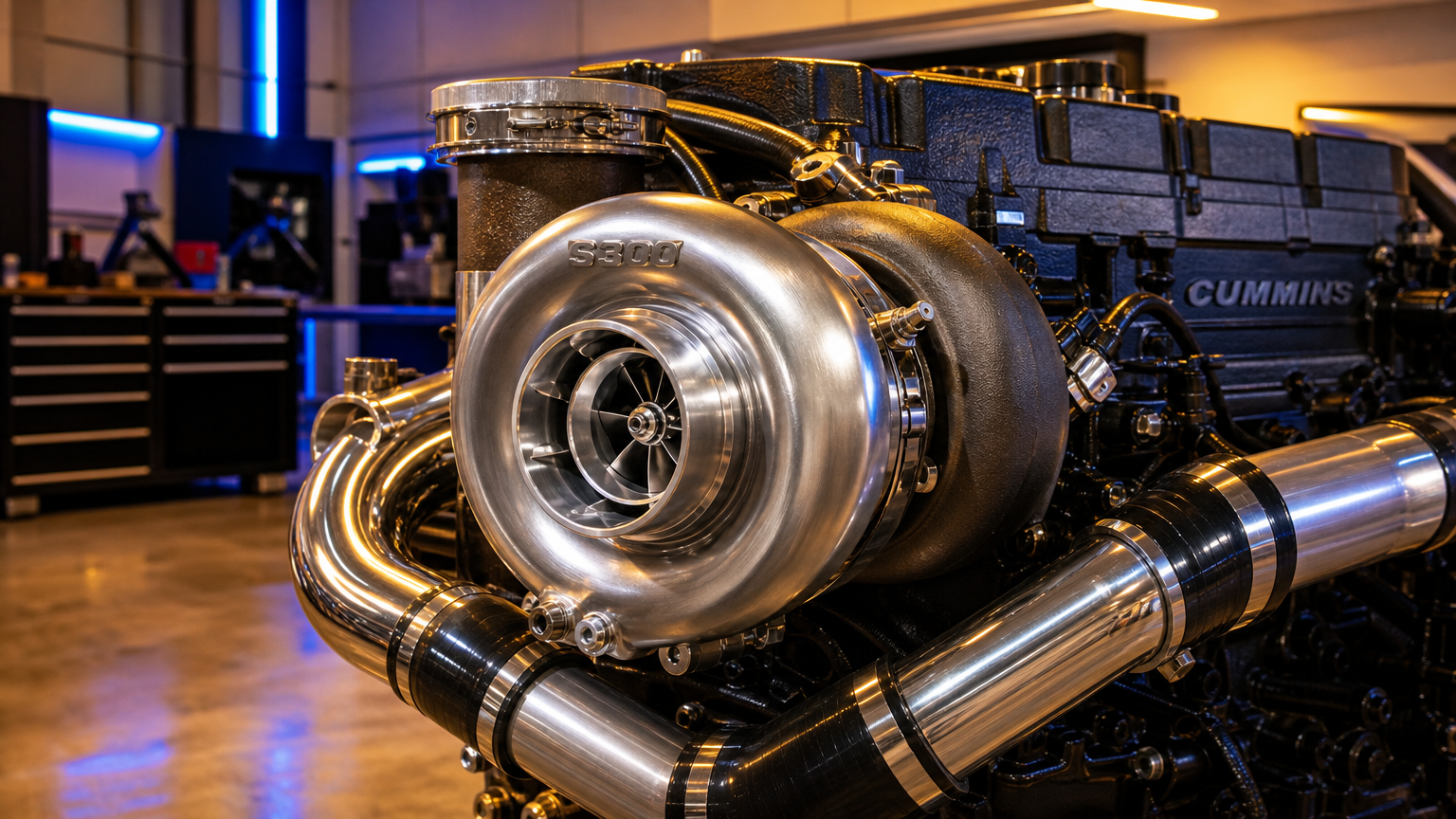
Diesel turbo upgrades Houston
Home/ Turbo & Forced Induction
Drop Forged Diesel  ·  Houston, TX

DIESEL TURBO
UPGRADES
HOUSTON

Compound turbo setups, single conversions, and S300/S400 builds for Cummins, Power Stroke, and Duramax. A system spec — not a plug-and-play installer.

300+
Turbo Builds Completed
S300
Compound Specialists
3
Platforms — All Three
100%
Dyno-Verified Boost
Plug-and-Play vs. System Spec

Bolting on a Bigger Turbo
Is the Easy Part.
The System Spec Is the Job.

A larger turbo moves more air. That's the straightforward part. What changes is everything that has to support it — the intercooler that cools the denser charge, the fuel system that has to deliver volume to match, and the calibration that has to account for the new airflow map, spool characteristics, and boost targets. A plug-and-play installer drops a turbo on and calls it done. We write the system spec first: what turbo for this platform and this use case, what intercooler, what fuel delivery capacity, and what the tune file needs to look like when the turbo is installed.

The fuel system that has to keep up with the turbo is always part of the conversation before a compound setup goes in. The intercooler the new turbo demands is sized to the boost target — not to the factory charge cooler that was built for a stock spool rate. And the tune written for the new turbo setup gets written after the hardware is on the truck — not before.
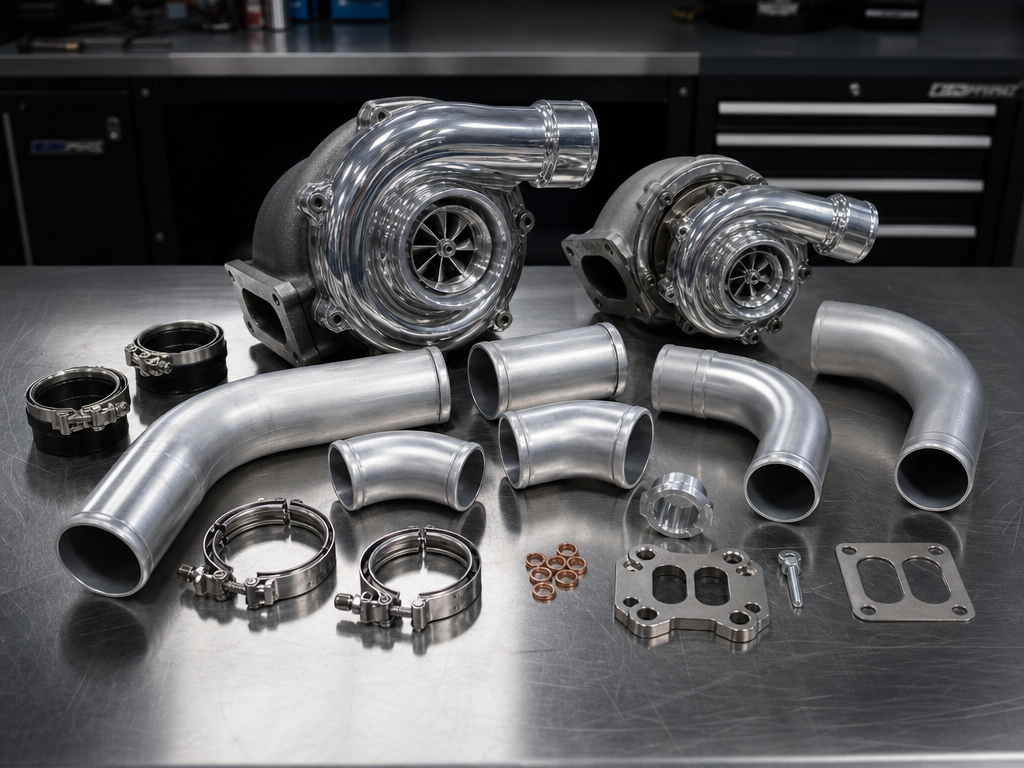
Compound turbocharger components
Turbo Configuration Options

Three Paths.
Same Requirement: Right for Your Build.

The turbo configuration that's correct for a sled pull competition truck is not the configuration for a towing truck or a street-performance daily. Spool rate, peak flow, thermal efficiency under sustained load, and packaging on your specific engine bay all factor in. We pick for the use case, not for the spec sheet.

Most Popular — Cummins
S300 COMPOUND

The S300 compound setup pairs a factory-location or slightly upgraded primary with a larger S300-frame atmosphere turbo that does the heavy lifting. Excellent spool characteristics for street and towing use, substantial power ceiling for competition, and proven across thousands of Cummins builds. The standard for the Ram 2500 compound build.

Cummins 5.9 / 6.7 Street & Competition Spool + Power
High Power — Any Platform
S400 COMPOUND

The S400 frame steps up the atmospheric turbo for builds targeting 600+ rwhp where the S300 becomes the restriction. Requires proportionally larger fuel delivery, injectors, and an intercooler spec'd for the boost. The right choice for sled pull and high-index drag competition — not a street build where the low-end spool matters more than peak flow.

All Platforms 600+ rwhp Competition
Single Turbo Conversion
BIG SINGLE

For builds where packaging allows it and the power target is achievable with a properly spec'd single frame, a big single can deliver excellent peak flow and a simpler oil and boost routing architecture. Spool is later than a compound setup — this matters for towing and street use. Better suited to high-power builds where peak flow matters more than low-rpm response.

Platform-Dependent Peak Power Later Spool
What a Turbo Build Actually Requires

The Turbo Is One Part.
The System Is the Build.

Every turbo upgrade creates a demand on the rest of the system. More air through the intercooler means the intercooler has to be sized for that flow — factory units are engineered for factory boost targets, and a compound setup runs well past that threshold. More power on the cylinder head means the fueling has to keep up — which means the lift pump, high-pressure pump, and injectors are all part of the conversation before the turbo goes in.

And when the turbo is on and the system is buttoned up, the ECM calibration gets rewritten for the new airflow map. Not adjusted. Rewritten — because the factory calibration was written for the factory turbo and its spool curve. A tune that isn't written for the new turbo is guessing at parameters the turbo didn't exist for when the file was written.

Turbo Selection for Use Case
S300 compound, S400 compound, or big single — selected for your platform, your power target, and your use case. Not upsold to the biggest unit on the shelf.
Intercooler Spec
Front-mount intercooler or upgraded core selected and sized for the boost target — not the factory charge cooler that wasn't built for compound pressures.
Fuel System Compatibility
Lift pump output, high-pressure pump capacity, and injector sizing verified against the power target before the turbo goes in.
Post-Install Calibration
Custom EFI Live calibration written after the turbo is on the truck — new airflow map, new boost targets, new fueling curves. Dyno-verified before the truck leaves.
Boost Tube & Oil Routing
Compound setups require proper high-pressure and low-pressure boost tube routing, oil feed, and drain lines for both units. We build this correctly the first time.
Where the Turbo Build Ends and the Next Problem Starts

More Air Means More of
Everything Downstream.

The turbo delivers denser, cooler charge air to the cylinders. What happens at the cylinder and downstream is a function of everything else: fuel delivery at the injectors, combustion efficiency with the tune written for this setup, exhaust flow through the system after the primary turbine, and thermal management of the engine and transmission under the new load profile.

A compound turbo build on a Cummins 6.7 that doesn't address the 68RFE or built Allison downstream is a tuned truck with a transmission that wasn't spec'd for the new power level. We look at the full system and flag the next weak link — whether that's the gearbox, the axles, or the cooling capacity — before the build leaves the shop.

For sled pull and competition builds, this conversation is particularly important — competition power levels stress every component in the driveline simultaneously. Start with a build consultation and we'll lay out the full system picture for your power target.
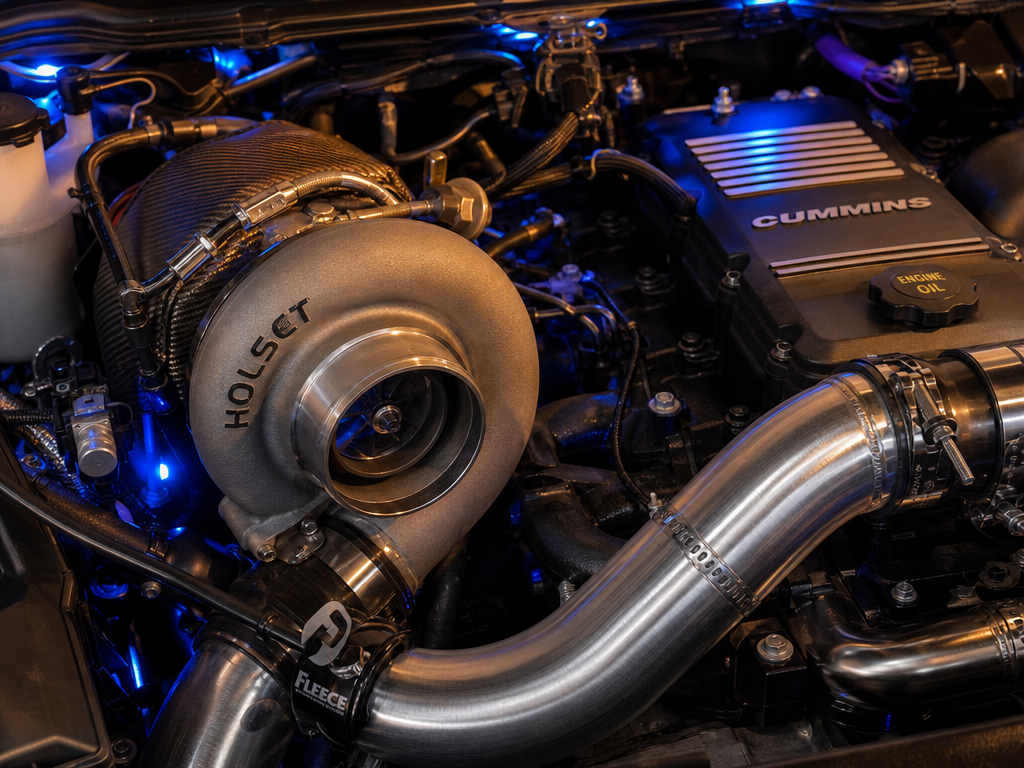
Compound turbocharger installation diesel
Common Questions

Diesel Turbo Upgrades FAQ

What we hear before every compound turbo consultation.

What's the difference between a compound turbo and a single turbo conversion?+
A compound setup runs two turbos in series — a smaller primary that spools quickly and feeds a larger atmospheric secondary. You get better low-end response than a big single and a higher peak flow ceiling than a simple stock upgrade. A single turbo conversion replaces the factory unit with a larger single frame — better peak flow at high rpm, later spool. Compounds are better for street/towing/all-around use. Big singles make more sense at high-power competition levels where low-end response isn't the priority.
Do I need an intercooler upgrade with a compound turbo setup?+
Yes. Compound turbos compress air through two stages — the charge temperature coming off a compound setup is higher than a factory single turbo, and the boost pressure is significantly higher. A factory intercooler wasn't sized for compound boost pressures. A properly spec'd front-mount intercooler is part of a compound build — not an optional add-on. We size it for the actual boost target, not the smallest unit that technically fits.
What platforms do you build compound turbos for?+
Cummins 5.9 and 6.7 are the primary compound platforms — the S300 compound setup has the widest application range and the most developed hardware for both generations. Power Stroke 6.4 also takes compound setups well. The 6.7 Power Stroke and Duramax LBZ/LML can run compound configurations at higher power levels. The L5P Duramax has more limited aftermarket options due to tuning constraints — we'll tell you honestly what's achievable.
Will a compound turbo affect my towing?+
Positively, at the right power level and with the right calibration. A compound setup with a tow tune calibrated for sustained load, proper exhaust gas temperature management, and appropriate boost curves will outperform a stock turbo under tow weight. The key is that the tune has to be written for towing specifically — not just max power. We write multi-tune setups for trucks that both tow and performance-drive.
How much power will a compound turbo add?+
On a Cummins 6.7 with an S300 compound, supporting fuel system, injectors, and a proper EFI Live calibration, 450–550+ rwhp is a realistic target depending on the build level. S400 compounds with full fuel system work can push significantly beyond that. But the turbo doesn't create the number — the full system does. The tune, the fuel delivery, and the intercooler are all part of what produces the verified dyno number you leave with.
Houston metro diesel performance service area
Spec the System — Not Just the Turbo

COMPOUND TURBO
BUILDS. HOUSTON.

S300 and S400 compound setups, single turbo conversions, and full system specs for Cummins, Power Stroke, and Duramax. Every build leaves with a verified before-and-after dyno sheet — not a manufacturer's peak flow claim. Book a consultation and bring the truck in.
Book Your Consultation → (713) 555-0181
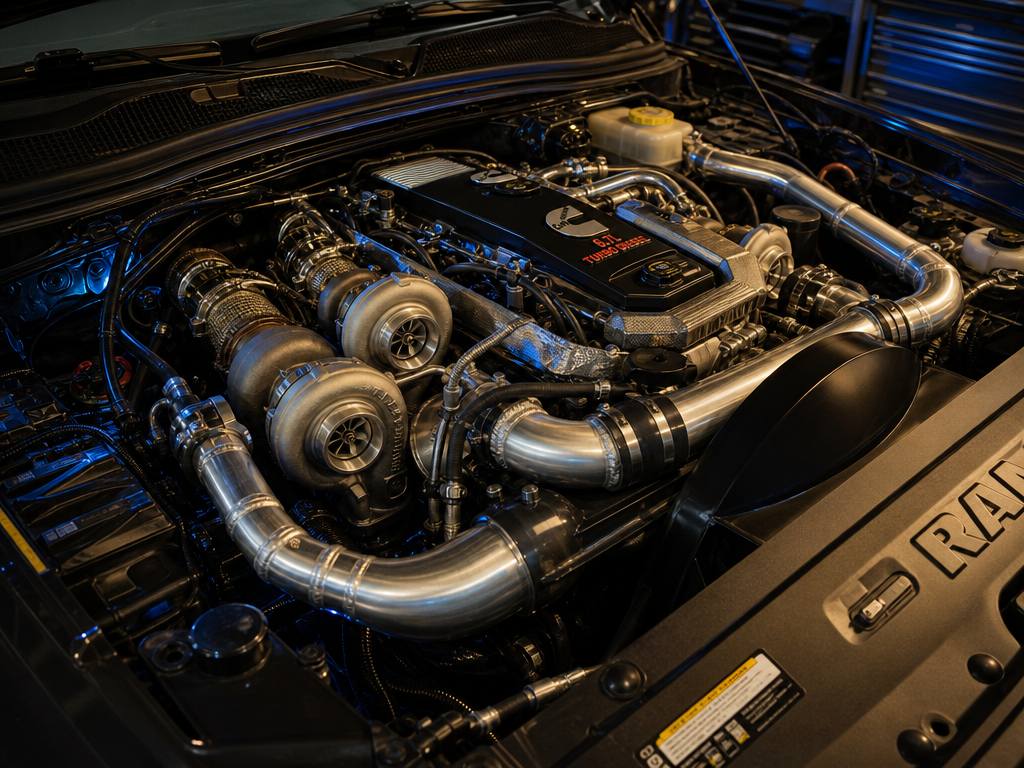
Compound turbo installation Houston