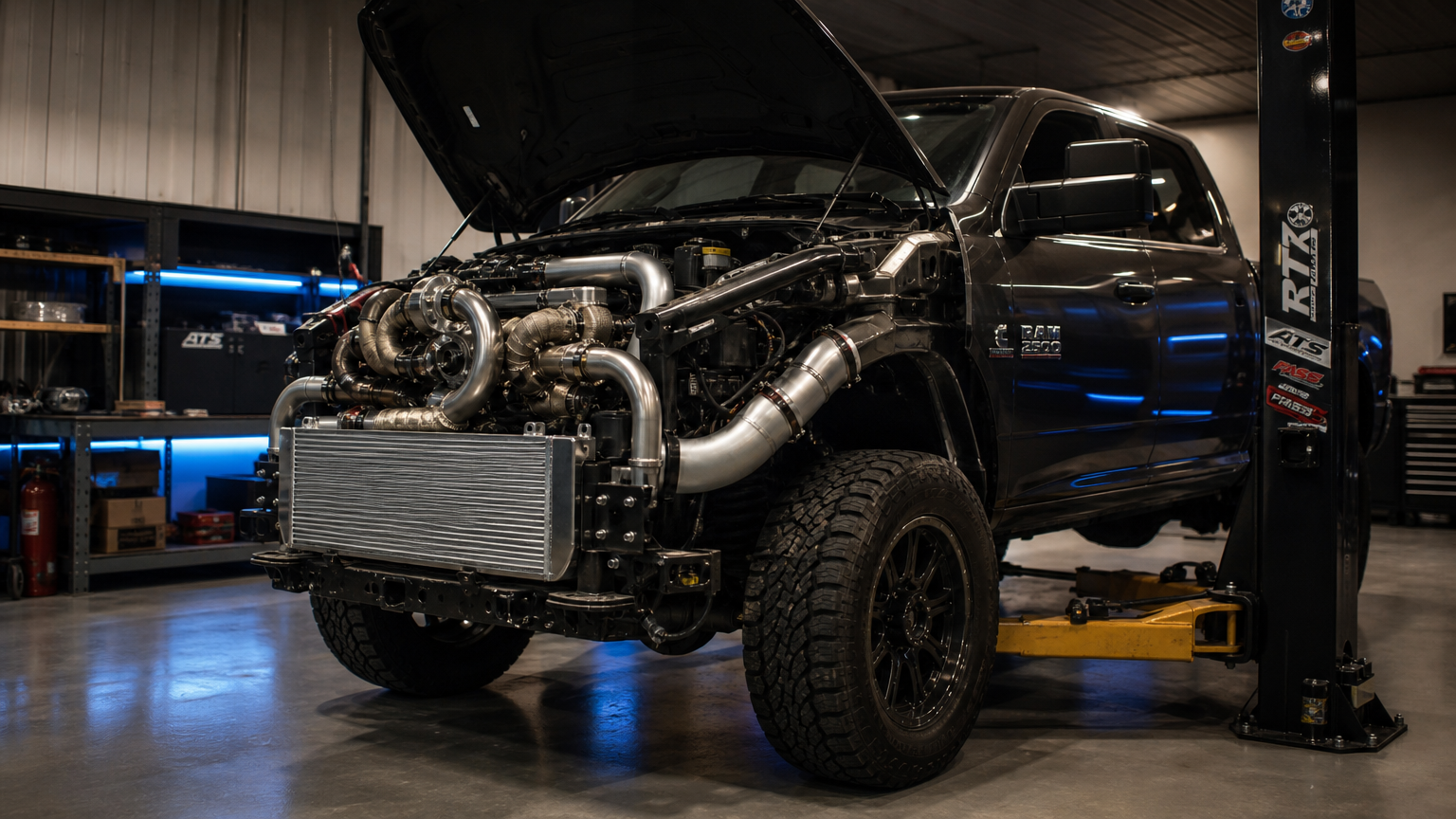
RAM 2500
CUMMINS
COMPOUND BUILD
The S300/S400 compound turbo build is the most-requested Stage 3+ path on the 6.7 Cummins. Here's how we build it, what it requires, and what it realistically produces.
A SINGLE TURBO
CAN'T DO WHAT
TWO CAN.
A large single turbo on a 6.7 Cummins makes big peak power numbers — but it spools late and produces a power curve that's narrow at the top and hollow in the mid-range where towing and daily driving actually live. A compound setup changes that completely.
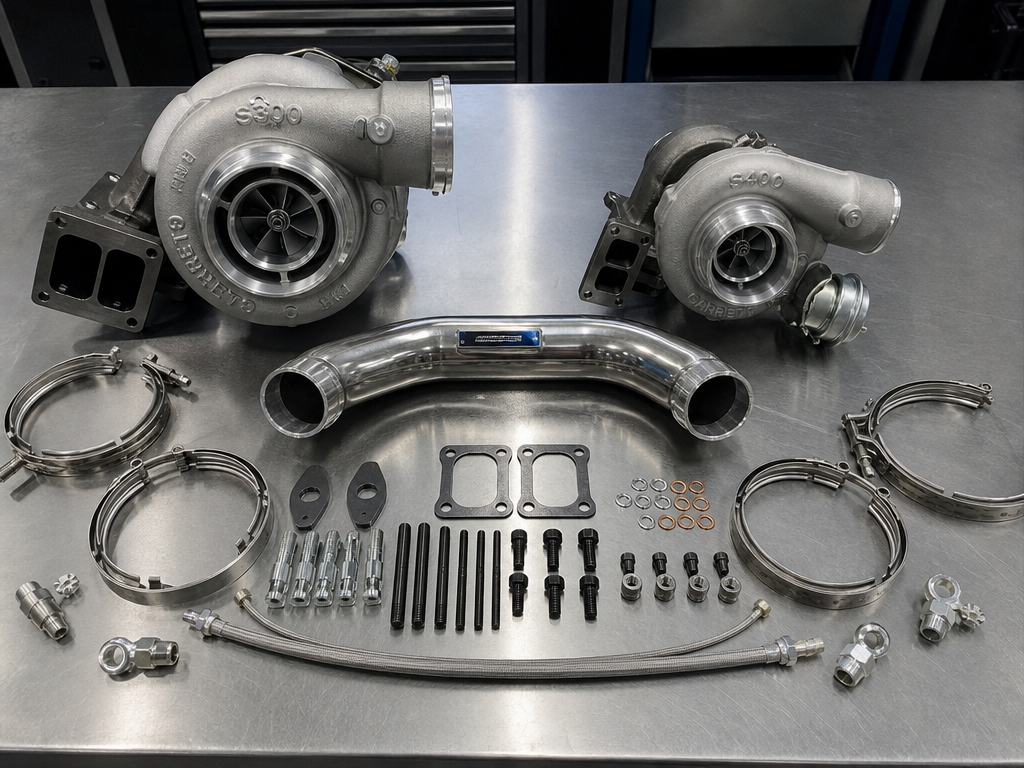
A small secondary turbo (the inner, or "secondary" in Cummins compound terminology) spools immediately and builds boost in the low-RPM range where the engine is most responsive. A large primary turbo takes over as RPM climbs, producing high-volume airflow at the top of the power band. The result is power that's usable across the entire RPM range — not just on a dyno sheet.
The compound build requires doing the fuel system correctly first — FASS lift pump and CP3 conversion for 2019+ trucks. The turbo sizing has to match the fuel delivery capability. The transmission needs to be built before a high-output EFI Live tune goes on. We plan all four systems at the consultation.
- FASS 150 or FASS 220 lift pump — fuel delivery foundation
- CP3 injection pump conversion (2019+ 6.7 Cummins only)
- S300 secondary + S400 primary compound turbo kit
- Intercooler upgrade — larger core, high-flow end tanks
- 68RFE or Aisin transmission build — compound torque requires it
- EFI Live Stage 3 compound tune — calibrated on dyno
S300/S400 Compound Configurations on the 6.7 Cummins
Compound sizing depends on the power target, use case, and whether the truck needs to also tow or compete. We size the combination at the consultation — bigger isn't always better for street and tow applications.
STAGE 3 STREET
STAGE 3+ HIGH OUTPUT
COMPETITION
Prerequisites That Can't Be Skipped
The most common mistake on compound builds is installing the turbos first and figuring out the supporting systems later. That sequence produces damaged injection systems, failed transmissions, and poorly calibrated engines. These are done first — before the turbo kit gets ordered.
The compound turbo build demands injection pump fuel supply that a stock lift pump cannot sustain. The FASS 150 is standard for Stage 3 street builds. High-output compound builds (S480 primary) get the FASS 220. Lift pump first — injection pump second — compound turbos third. Non-negotiable sequence.
The 2019+ 6.7 Cummins uses a CP4 injection pump from the factory. The CP4 cannot sustain the injection rail pressure demand of a Stage 3 compound build — catastrophic pump failure is the outcome, not a possibility. CP3 conversion is completed before any compound turbo work begins on a 2019+ truck. 2013–2018 trucks are already CP3 — no conversion needed.
A compound turbo setup produces significantly more compressed air volume than a stock single turbo. The stock intercooler core cannot cool that air mass effectively — inlet temperatures rise, detonation risk increases, and power ceiling drops. A larger-core intercooler with high-flow end tanks is part of the compound build package, not an optional add-on.
A compound 6.7 Cummins produces 900–1,200 lb-ft of torque at the crank. The stock 68RFE torque converter and clutch pack were calibrated for 450 lb-ft. A Stage 3 compound build without a built transmission produces a broken transmission within a few hundred miles. The 68RFE or Aisin gets built before the tune goes on. See the transmission upgrades page for what a built 68RFE or Aisin involves.
EFI LIVE
STAGE 3
COMPOUND TUNE.
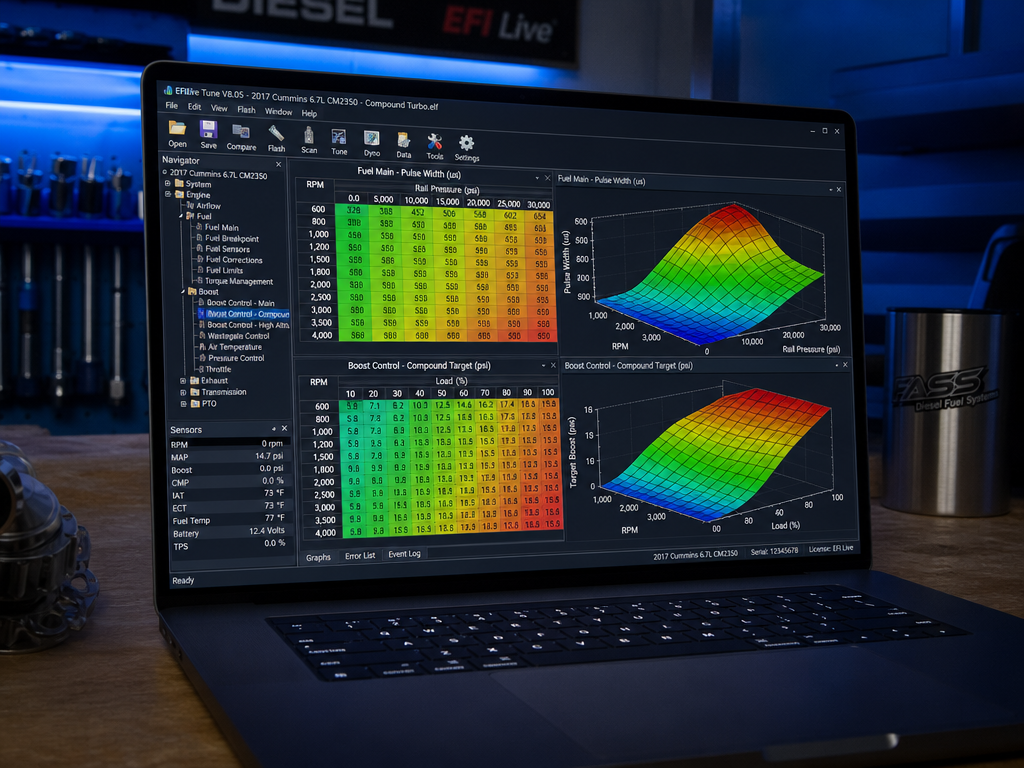
The compound tune is not a Stage 2 tune with the fueling tables turned up. The compound turbo system has different boost characteristics, different EGT behavior, and different charge air temperature curves than a single turbo. The calibration has to be written for the specific compound configuration installed — primary and secondary sizes, intercooler core, and fuel delivery capacity all inform the tune.
We calibrate on EFI Live, verify power output and EGT curve on the chassis dyno, and deliver a multi-file tune (street, tow, and economy profiles where applicable). The street and tow profiles are separate calibrations — not the same fueling table with different shift points.
For the full platform context, see the Ram 2500/3500 Cummins page which covers Stage 1 through Stage 3 in the context of the full platform build path.
Ram 2500 Compound Turbo Questions
What we're asked most about the S300/S400 compound Cummins build.
READY TO BUILD
THE COMPOUND?
Bring the model year, current mods, and the power target. We'll scope the full build — fuel system, turbos, trans, and tune — from the consultation forward.
BOOK YOUR CONSULTATION